Eat. Sleep. Dream. Twitch. Wake. Stretch. Check the kitchen. Curl up. Take a nap. Dream of eating. Wake. Eat. Take a bath. Gaze out the window. Sniff the breeze. Eyes droop. Fall asleep. Oh my god. I’m my cat.
Scattering Ashes
I described James as “the man with a tooth.” That’s it, one tooth—and no sense. His ex-wife Christina claimed he had great horse sense, which was good since he was a stable hand at Pimlico Race Course. Perhaps she meant that he had the sense of a horse, since that animal has been known to eat itself to death, and James had the sense to drink himself to death. Or was it drugs?
Christina was known as the keeper of strays. She had Casey the black Lab and Giddy the cat—and James—to show for it. Even though she divorced him three years ago, she never wanted to leave him. He left her no choice.
At eight months pregnant and with two-year-old Paul by her side, there Christina stood on the curb outside their apartment. They’d just been evicted because James had gambled away the rent money again. Despite her desire not to leave James, everyone in her family told her she couldn’t stay with him, so she went home to live with her parents, Ann and Martin. I wished I could say they lived happily ever after. If they actually liked and respected each other that may have been possible, but Christina didn’t like or respect herself, and Martin and Ann made for tough critics, so there they were—animosity leaking out all over.
James led a life of convenience, which galled Ann to no end. He showed up at his former in-laws’ to see his sons Paul and Matthew when he felt like it—and he didn’t when he didn’t, even if he’d promised them that he’d be there.
Last Sunday Christina called to tell me James had died—of Hepatitis C? of cirrhosis of the liver? Hard to pin down with so many choices. He’d died on their wedding anniversary. She said, “Some people think it was strange we still celebrated our anniversary, but we still loved each other. I danced his hospital bed around the room.” Her tone told me it was a happy lark. History told me he was barking at her the whole time.
I called the house later and got Ann, and I asked her how Christina was doing. She said, “She’s happy now. She sees herself as the grieving widow.”
She told me Christina was planning to hold an ashes ceremony at the race track. How fitting to commemorate his lifestyle by scattering his ashes where he’d destroyed his life.
I understood wanting to feel as if you belonged in this world. I understood the desire to be loved. But I had chosen to eschew the familiar for the healthier, no matter how scary and foreign the first step—and the next step—could be, because if belonging to a world encourages and preys on destructive behavior, then get me on the next bus to somewhere else.
With these thoughts surfaced my real dilemma: What does a person wear to a funeral at a race track? Ann suggested blue jeans. I said, “Would that seem disrespectful?” She said, “99.9% of everyone there will be in jeans, and some of them might even be clean.”
And I worried about my irreverence!
So off I went to Pimlico on a sunny fall day. I had this image of poor dregs of the earth working the track (James’s one tooth came to mind), and the thought of being robbed for drug money made me leave my diamond studs at home. Upon arrival I saw an Yves St. Laurent clutch and black leather jackets mixed in with muck boots and torn flannel work shirts. These people worked—hard jobs for a meager living.
We gathered track-side.
James’s mom Adele talked first, about how God never gives us more than we can bear, but “God, to lose my husband and my son in one year is too much.” Mind you, the husband’s ashes had been scattered at the same track for the same reason as his son’s—death by Jim Beam—three months earlier. She went on to say, as her hands shook and her eyes teared, “James was a son, a brother, a husband, a father.” Technically, she couldn’t be faulted there. Then she read a poem, imploring, “Always remember my smile. Remember my kind words and not the harsh ones. Remember my good deeds and not what I might have done wrong.”
Clearly James had counted on people’s kindly selective memory for years.
As Adele finished Christina cleared her throat, called Paul and Matthew to her side, and stood at the rail holding the black laminate box filled with ashes. She welcomed the people surrounding her, “James wanted you to be here, because you were always family to him.”
She thanked the woman who hired hot walkers at the track, for inviting Christina back last summer to work there again. “That was the happiest we’ve ever been. This place was home to me, where James always wanted to be, and this is where I have to say goodbye.” She broke down and sobbed, and the kids broke down and sobbed. Finally she managed to say, “But I never want to say goodbye to James, because I still love him.”
And therein lay the problem. A person couldn’t let go if she believed the sinking ship was her salvation—and Christina was nothing if not a believer in boat anchors.
Mother and sons, joined at the hip, staggered to the center of the track.
A woman behind me was trying to turn on a boom box to play James and Christina’s favorite song. It blasted once, Adele wheeled on the person and snarled, “What the hell was that?”, and we all turned our attention back to the track.
Christina opened the plastic bag filled with grayish-white cremains and held it for Paul and Matthew to scoop out handfuls of their father’s ashes. Like any eight-year-old boy, Paul flung it with a sidearm heave across the track. Matthew chucked mittfuls of it underhand straight up in the air so the wind caught most of it and swirled it around, landing more on him than on the ground. When they were done the boys were smudged with the stuff, as they wiped their hands on their coats and jeans.
Thoughtful people handed them paper napkins to wipe their hands. Being conscientious little boys who never littered, they threw the garbage in the trash can.
We moved from the track towards the canteen where a Miss Niki had set out cookies and coffee. I sidled up to Christina and walked with her. I felt myself speaking in platitudes. No real connection, no real heart.
A young man, Latino, beautiful dark curly hair and blue eyes clear and light as water, came up to her and offered her a race towel. It read “Nose for Nettles” or some such horse name. He said it was from James’s favorite horse. Christina took it without a word. I said, “Oh, gosh. That’s so nice.”
Who knew? He could have been James’s drug dealer, but I still thought it was a kind gesture that deserved acknowledgment.
The workers’ canteen was pretty dreary, although “functional” would be kinder. It had to serve a lot of people who worked in a dirty work environment. People quickly got their food and took to tables and chairs, knowing their way around.
I didn’t know anyone to talk to, so I had wallflower eyes as I cast about for something to look at. Pictures of James had been taped to the wall—as a boy, a young man, a husband to-be at their wedding rehearsal. (I was the only person in the wedding photos smiling, probably because I wasn’t getting James as an in-law.)
There were James and Christina cooking dinner at home and playing on vacation —why wasn’t he ever smiling, not even with his kids?—and the leading-horses-out-of-the-stables photos, where perhaps he was smiling.
I searched, but I never found the coffee urn, so I had some orange juice and a cookie, and I tried not to stare as I eavesdropped, for lack of knowing what else to do.
I overheard one man tell another to be sure and sign the card. Next to the card was an industrial-sized margarine tub with a scrap piece of paper rubber-banded to it with a scrawled note: For The Boys. (Surely these people didn’t know Christina and The Boys lived in a mansion.)
I realized not everyone was washed. My sensitive nose was upset by the sour body odor, but something more. With time I realized it was also sour liquor sweat.
Still feeling awkward, I finally sat across from a woman who’d been sitting alone since we’d first entered the canteen. She never looked at me.
One of the stable hands produced another tape player, and at long last we heard James and Christina’s song, John Denver singing a duet with Placido Domingo that was lofty and loud. Adele announced in an angry tone, “I can’t stand this,” before she left.
Of course, as expected—and per chance envisaged by James as he planned his ceremony just before his death—Christina and the boys broke down.
I went to hug them. Paul broke away from the pack, wanting to be alone. (Me, too, Paul.) Christina mouthed to me, “Go watch him.”
So there Paul sat on the floor in the pool room, with the pool table and the pinball game and the poker machine, trying to be alone, and me kind of watching him because I still had nothing else to look at, poor kid.
I moved to the door that led outside and turned my back to the room, trying to give him a little privacy, so I was unintentionally listening to Adele’s conversation. She was telling people that if she wanted to walk around the house naked there was no one left to mind but the dog. I tried to smile, strangers who had met before but didn’t remember each other, but she wasn’t responding.
I have an over need to include people. I think some people have an under need to include.
After twenty minutes of my awkwardness, I thought, ‘Christina’s always saying, “This is home. The boys are safe here. They’re family here,” so why the hell am I staring at her son?’
Right when this dawned on me and I started to leave, Christina came out and said, “You don’t have to watch Paul.”
“Good, because I’m pretty sure he just wants to be alone. I think he’s okay.”
“Of course he’s okay. He’s safe here. This is family.”
I went inside and listened to a speech from Miss Niki, how James was one of her children and how James always told Paul and Matthew, “Go hug Miss Niki,” and how Christina gave her school pictures of Paul and Matthew that she had on her living room. The young Latino came up to Christina and gave her a picture of James sprawled out on a sofa in the service shed. He told me in a discrete and respectful tone, “James sold me his car just before he—” near whisper “—he passed. She’s his widow. She should have this stuff I’m finding in it.”
Technically, can an ex-wife be a widow?
I left as Miss Niki gathered people for The Lord’s Prayer. Again, platitudes from me to Christina, saying things that probably would seem supportive of her delusions and past-tense fantasies, but what was I going to do, slap her and yell, “Snap out of it!”?
I said, “I’m going to head out if you’re okay.”
She smiled that beatific smile of belonging and said, “I am. I’m with family.”
(God, it gets redundant.)
We made plans to go out Monday night, to talk (I was planning my get-therapy, get-a-new-life speech already), and I left.
She called late Monday afternoon, sounding hang dog, to say the boys were having a meltdown and she couldn’t leave them.
She often said things to them like, “I’ll never leave you alone” and “No one else would have us,” which made me wonder if they had meltdowns and she was there for them, or if she worded things that worked them into a meltdown so she felt needed.
Before she hung up she told me they’d had a great time at the track (must have gotten a whole lot better after I left). Later that day they’d held their private ceremony at James’s favorite fishing pond where they’d scattered the rest of his ashes. Christina told me that before they headed back to the house Casey the Lab went and rolled in them.
When I saw the old girl again I gave her an extra belly rub for knowing the true value of the man, and I whispered in her long, silky ear, “Next time you’re at the pond, feel free to tinkle on his ashes for me.”
The Cowardly Lion
People ask me why you’re leaving.
I tell them I don’t have the courage to ask.
People ask me when you’re leaving.
I tell them I don’t have the courage to look at my calendar.
People ask me why New Mexico.
I tell them I don’t have the courage to think that far away.
I do not avoid talk about your leaving
because I am mad at you or dismiss your choice.
I do not talk about your leaving
because I will miss you so dreadfully I cannot speak.
But I will listen.
You can find me, if you look under the blanket
I’ve pulled over my head,
a blanket of spring’s daffodils and summer’s daisies,
autumn’s asters and winter’s barren branches.
You’ll find me, awash in the tears that feed their very roots.
I will not say “good-bye” to you.
Good-bye means nothing to friends who mean everything.
I will say “so long” to you –
wherever, whenever, whyever you may go.
Open Door Policy
The most-often committed crimes are theft and burglary – in my town, my county, the country, and probably the world. Crimes of convenience.
When the night is cool – in the 50s, say – I leave my bedroom window open. I wake up nervous at being vulnerable, leaving myself exposed, inviting a burglar (bad enough) or worse. To the cats’ chagrin, sometimes I panic and slam the window shut.
Not a summer passes that I don’t discover I’ve left a window open while I’ve been out all day – and ye gods sometimes I’ve forgotten to close and lock an entire door.
Good thing the criminals of convenience haven’t met my thief of memory.
You know. Yet.
A box
I want to give you a box of dishes
to hurl them, smash them, break them
on the floor.
Saucers fly.
Teacups shatter.
Zorba the Greek’s got nothing on you.
Stomp the box to a yowling, howling pulp.
I want to give you a box of comfort
to curl inside – hiding, quiet
quiet except for the teardrops
that plink against the cardboard.
Cut air holes. Remember to breathe.
Anger sucks all the oxygen out of life.
Love doesn’t die.
Sometimes it just can’t grow.
I want to give you a box of boxes
to fill with what-ifs, to burn.
“I’m sorry for hurting you.”
You say. Or did she?
In your hands, a little box,
half-full of hard-won answers,
pokes you as you hug good-bye.
© Copyright 2012, Jane Harkins. All Rights Reserved.
Red Cross
Every 59 days I gird myself, head to the nearest drive, and give blood. All goes smoothly most of the time, but no matter what happens a technician is taught to exude confidence so the donor doesn’t leap off the table and run for the door, despite bribes of cookies and a juice box.
There will be pain, but seriously – no worse than picking a scab or stubbing one’s toe. Yes, this is the pep talk I give myself as I provide my medical and travel history, right before Wanda drills a hole in my finger.
Ouch.
“Okay. Let’s see those elbows. – Excellent. We won’t have any problem at all. – Squeeze your fist and hold. – Stick and sting – we’re in.” Wanda pauses to assess the flow. “Good – good – oh. Wait. It stopped. What happened?”
She pokes and prods, maintaining her game face. “Let me just…”
I flinch.
“…oh that must have hurt. I’m sorry. One more time. Okay?”
“Since I’m here….”
Jab jab jab prod jab. “Nope. Hmm. Carol?”
“You need some help?” the supervisor asks.
“Just a little.”
“Be right there,” Carol assures us.
“I’ll keep trying,” Wanda assures us.
All the other donors who started about the same time I did are headed to the snack bar. Carol joins us, sees my longing gaze. “Would you like some water?”
“Oh yes please.”
Carol gives Wanda this task while she attends to the recalcitrant needle. She pokes and jabs, presses on the vein, tugs on the tourniquet, gets nowhere. “Oh. I see. When she rocked, you rolled.”
Not the needle. Just a tricky vein.
“Would you like to try the other arm?”
I shrug. “Sure.” My enthusiasm has waned, but not my determination.
The blood that didn’t go in the bag runs down my elbow and pools on the table. “So now you want to bleed,” Carol says, cleaning me up.
A fresh kit, fresh swabs – again we start. Pop.
“You can tell that one went in,” Carol crows. “You nearly came off the table! And look – you’re flowing now!”
I drink my water in celebration and don’t watch as I fill the bag.
I listen to the instructions – “Don’t smoke, don’t lift weights, drink extra water, and don’t skip any meals.”
I head to the cookie basket ready to start on that last one, sporting my “I Gave Blood” stickers and several Band-Aids like badges.
© Copyright 2012, Jane Harkins. All Rights Reserved.
2220 Paris Time
It’s barely dusk, and it’s barely 10:20 p.m.
Tonight I can see the half moon through the open window and the reflection of the brilliantly lit Tower in the window itself, tilted open to let in cool air and the noisy city.
Today I bought a pair of shoes. I’m a sucker for a nice old man salesman or I probably wouldn’t have bought them. But I couldn’t resist.
The sitting area in his shop was the size of a suitcase, and it was filled with a counter stacked with shoeboxes barricading the cash register, four chairs for fitting – one of which was behind two more stacks of shoeboxes – and two other customers.
The salesman spoke no English, and I spoke no French, including body language. When he pointed to his cheek I didn’t understand that he would follow me and I would point to the shoes in the window that I wanted to try on. His shop partner translated the action, so off we went.
The old man nodded at my pointing finger, took my European foot size with the old-fashioned silver-and-black measuring device, and worked his way into the back, past towers more boxes, where he disappeared for many minutes. At last he returned with a box just for me. I took off my sandals and looked up to take the left shoe from him, but he reached past my hand, took my ankle, and guided my foot into the shoe.
Still bent over, he placed my foot on his thigh and proceeded to lace up the shoe. I felt like a well-cared for little girl.
He repeated the process with the right shoe.
I grinned my 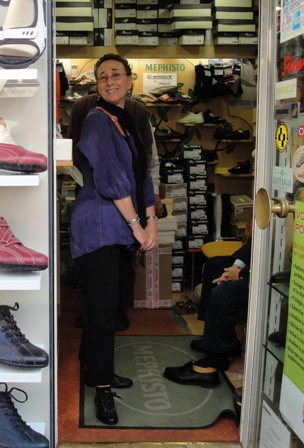 pleasure at this grandfatherly treatment, which I imagine he took for a sale. And really – I couldn’t say no.
Before he turned to ring me up, he asked me something in French. I’ve yet to advance past merci and bonjour and bonsoir – though tonight I was taught bonsoiré from a fruit vendor, whose smile lit his round, brown face as he held his arms out round and wide, to show me “all encompassing” – so I couldn’t answer the nice, grandfatherly man. Even though his partner translated for him, I still couldn’t answer the question, because I would swear he asked, “What is the population of Alaska?” – and at my puzzled look clarified with, “How many people are there in the world that eat bread?”
I paid the man and thanked him profusely before rejoining my travel mates on Rue Cler – my now- favorite market street.
I have new shoes that hurt my already sore feet – and an utterly delightful memory that warms my heart.
Bonsoiré.
© Copyright 2012, Jane Harkins. All Rights Reserved.
To Know a Place
How can everything be a blur when we were moving at the speed of a walk? Miles and miles of walk.
At last we’re seated, in the cool dark of the Westin Hotel near the Place de la Concorde – not because we’re guests here but because of the Internet and the bathrooms, and because it’s cool and dark.
Aren’t big, faceless hotels nice? No one is asking us if we belong, if we’d like to move along.
What I’d like is a nap. I think their laissez-faire attitude might stop shy of a room.
Perhaps if we sit here long enough, my mind will slow and I will recall individual images:
The rows of concrete rosettes on the underside of the Arc de Triomphe, stretched over our heads, over the head of the Tomb of the Unknown Soldier.
Meeting the tiny dynamo of a woman on the Metro who has lived so many places that I’ve lived – South Florida, Michigan, Maryland – except I was born in Massachusetts and she was born in Brazil. She and her daughter waved goodbye and jumped off the subway at the Eiffel Tower stop.
The Eiffel Tower, around which the city turns, appearing unexpectedly around a building or over the treetops, 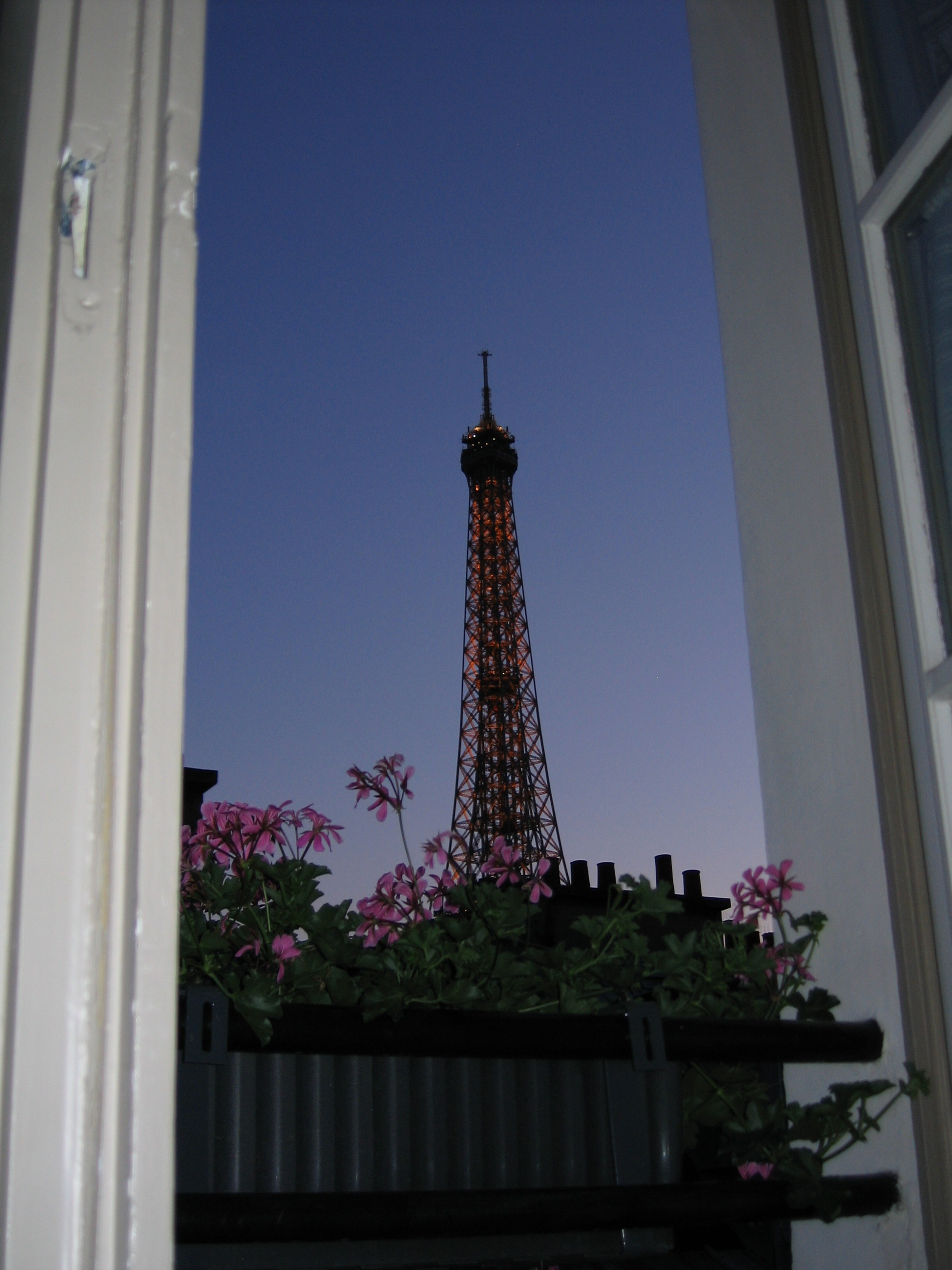 slowing me, the blur clearing. Colors quiet and become solid.
Near the foot of the Tower are cafés. I don’t know one from the next, but I’m drawn to the red awning and the wood chairs burnished shiny rich having been polished by the sliding on and off of so many derrieres.
The peach-strawberry smoothie at Haagen-Dazs along the Champs Elysées: cool and quenching – and only 7 euros!
Store upon store upon store of expensive everything. It’s fun to look in the window of Cartier. And funny that the giant clock hanging outside the Rolex store gives the wrong time.
The City of Light is known for being a walking town – as in to know the place by walking it, to be le flâneur. I fear if I travel any faster than a walk my head would never stop spinning and I would have seen all these fabulous sights for nothing. Nor would I appreciate so much at night settling into my room, with a view of the spindle that is the center to this whirling hub – Le Tour Eiffel – filling my view, bright on dark, until my eyes close, and I feel no more blur.
© Copyright 2012, Jane Harkins. All Rights Reserved.
In Paris with our Ps and Qs
It’s easy to forget things when you’re traveling. I forgot my toothbrush. And since my French consists of saying ‘Good day’ and ‘Thank you’ I haven’t figured out how to replace it yet.
Yes, Parisians can be haughty and cavalier to the point of being brusque. – It’s their city. Leave them be. – Most of the time they respond nicely to good manners. Greet the sales clerk as you walk in the store, the desk clerk at your hotel, your waiter.
Say, “Bonjour, madam” or “Bonjour, monsieur.” You’ll be rewarded with same – and sometimes much more. Most Parisians know at least a smattering of English. They’ll laugh at their own mistranslations and take yours in stride.
The street artist must be charming or he can’t sell you his work, but he’s like most artists: if you show your appreciation he’ll love you forever – or at least until the end of the sale.
French waiters are efficient and quick, which can be daunting when they’re in a hurry for you to decide and you can’t tell the difference between the Terrine de Saumon aux Epinards and the Aile de Raie aux Câpres. But oh when you land the waiter with charm and wit, such as we did.
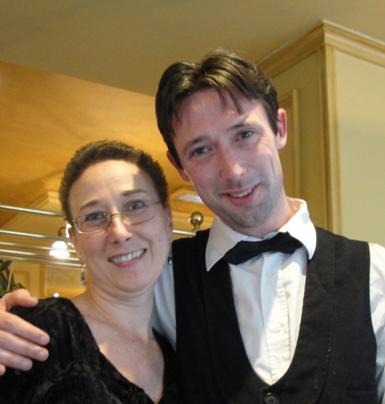 Cute to the bone with a boyish grin, Jonathan corrected my French matter-of-factly and took our picture with “But of course – it is my second job: photographer.”
Unlike most American restaurants where you’re handed multiple receipts in the ubiquitous black holder without explanation, he handed each piece of paper to me separately: “This is your receipt. This copy is for you.” He paused. “This one is for me. May I have your autograph please?”
“Merci,” I replied.
I think I’m afraid to say anything in French for fear the natives will begin speaking to me as if I actually understand them. It happens, but the notion is quickly dispelled with a smile and an awkward “Non. Just bonjour.” They usually smile back and nod, understandingly.
I know it’s easy to forget things when you travel, but with a word of thanks in another person’s language and a smile in my own, things, such as toothbrushes, are easily replaced…so long as I don’t forget my manners.
© Copyright 2012, Jane Harkins. All Rights Reserved.
Trees of Life
In New Hampshire, twelve sugar maples circle our lawn
so vast it takes Dad on the tractor and me and Mom with wide wooden rakes
to roll the carpet of leaves, knee deep, to the edge of the woods
at the foot of a stand of white birch,
pencil thin trunks, golden yellow leaves,
papery bark I write love notes on
to send to my favorite ever boyfriend
in Alabama, who throws magnolia cones
for his retriever Beau to chase
into the pond, to fetch amidst
the roots of the weeping willow,
though I never cry when we we’re together
under loblolly pines at Chewacla State Park,
midnight blue, we make love
on the splintery picnic table
before I drive south, past orchards
of waxy green orange trees, the car
filled with the scent of wedding blossoms
through a mangrove swamp turning water a tannic brown,
the sun turning me dark like a cup of tea,
the smell of iron primordial
on the coast, I stand on a beach, invisible
in the sun’s glare against sand white as bones,
and hear the palm tree whisper to me.
© 2011, Jane Harkins. All rights reserved.

