Red Cross

Every 59 days I gird myself, head to the nearest drive, and give blood. All goes smoothly most of the time, but no matter what happens a technician is taught to exude confidence so the donor doesn’t leap off the table and run for the door, despite bribes of cookies and a juice box.

There will be pain, but seriously – no worse than picking a scab or stubbing one’s toe. Yes, this is the pep talk I give myself as I provide my medical and travel history, right before Wanda drills a hole in my finger.

Ouch.

“Okay. Let’s see those elbows. – Excellent. We won’t have any problem at all. – Squeeze your fist and hold. – Stick and sting – we’re in.” Wanda pauses to assess the flow. “Good – good – oh. Wait. It stopped. What happened?”

She pokes and prods, maintaining her game face. “Let me just…”

I flinch.

“…oh that must have hurt. I’m sorry. One more time. Okay?”

“Since I’m here….”

Jab jab jab prod jab. “Nope. Hmm. Carol?”

“You need some help?” the supervisor asks.

“Just a little.”

“Be right there,” Carol assures us.

“I’ll keep trying,” Wanda assures us.

All the other donors who started about the same time I did are headed to the snack bar. Carol joins us, sees my longing gaze. “Would you like some water?”

“Oh yes please.”

Carol gives Wanda this task while she attends to the recalcitrant needle. She pokes and jabs, presses on the vein, tugs on the tourniquet, gets nowhere. “Oh. I see. When she rocked, you rolled.”

Not the needle. Just a tricky vein.

“Would you like to try the other arm?”

I shrug. “Sure.” My enthusiasm has waned, but not my determination.

The blood that didn’t go in the bag runs down my elbow and pools on the table. “So now you want to bleed,” Carol says, cleaning me up.

A fresh kit, fresh swabs – again we start. Pop.

“You can tell that one went in,” Carol crows. “You nearly came off the table! And look – you’re flowing now!”

I drink my water in celebration and don’t watch as I fill the bag.

I listen to the instructions – “Don’t smoke, don’t lift weights, drink extra water, and don’t skip any meals.”

I head to the cookie basket ready to start on that last one, sporting my “I Gave Blood” stickers and several Band-Aids like badges.


© Copyright 2012, Jane Harkins. All Rights Reserved.

2220 Paris Time

It’s barely dusk, and it’s barely 10:20 p.m.

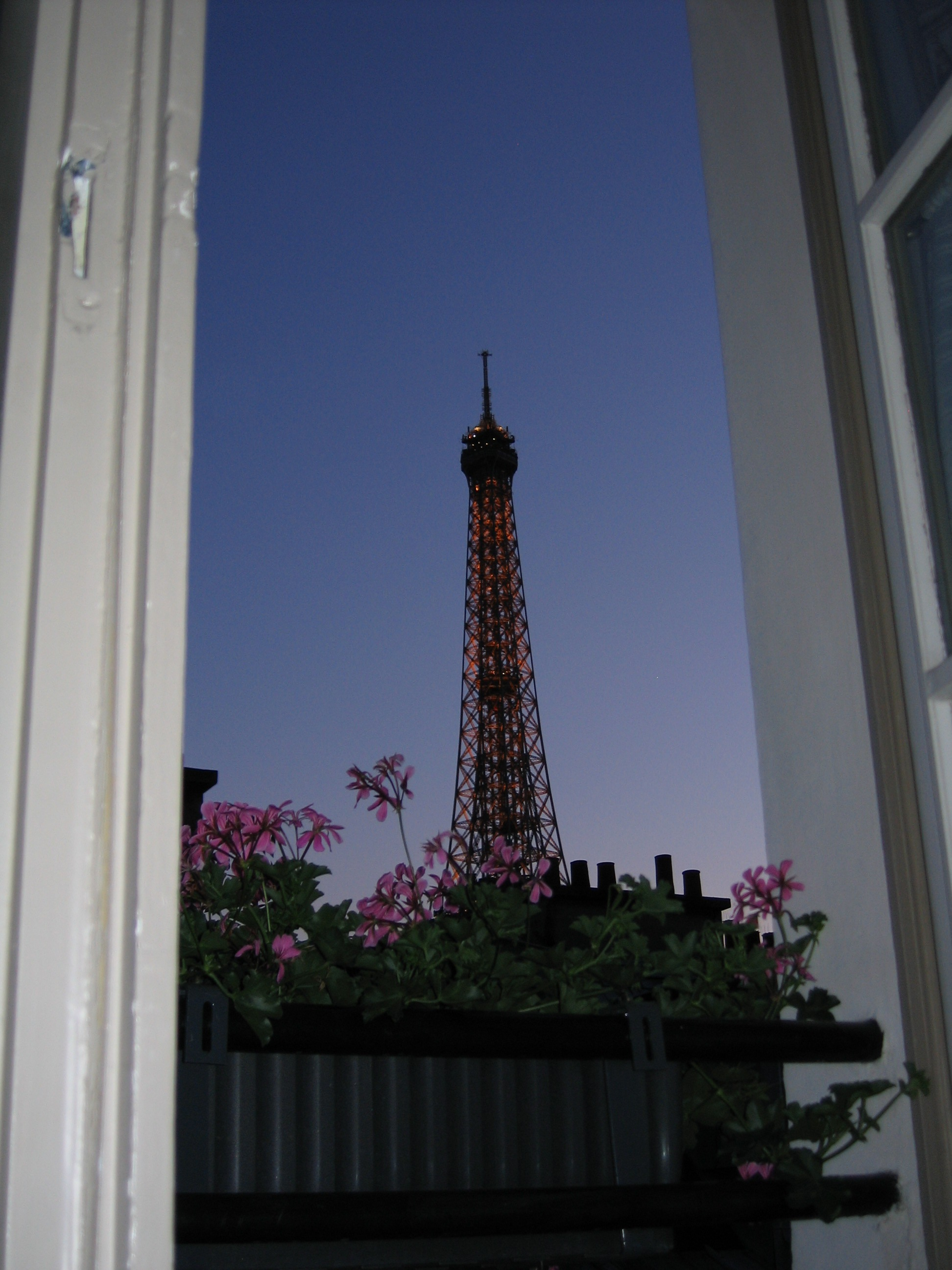
Tonight I can see the half moon through the open window and the reflection of the brilliantly lit Tower in the window itself, tilted open to let in cool air and the noisy city.

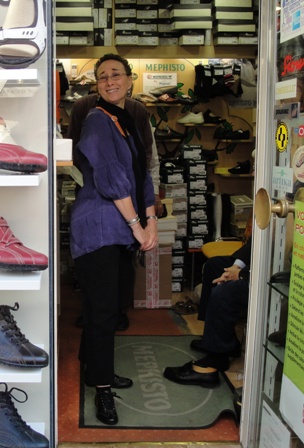
Today I bought a pair of shoes. I’m a sucker for a nice old man salesman or I probably wouldn’t have bought them. But I couldn’t resist.

The sitting area in his shop was the size of a suitcase, and it was filled with a counter stacked with shoeboxes barricading the cash register, four chairs for fitting – one of which was behind two more stacks of shoeboxes – and two other customers.

The salesman spoke no English, and I spoke no French, including body language. When he pointed to his cheek I didn’t understand that he would follow me and I would point to the shoes in the window that I wanted to try on. His shop partner translated the action, so off we went.

The old man nodded at my pointing finger, took my European foot size with the old-fashioned silver-and-black measuring device, and worked his way into the back, past towers more boxes, where he disappeared for many minutes. At last he returned with a box just for me. I took off my sandals and looked up to take the left shoe from him, but he reached past my hand, took my ankle, and guided my foot into the shoe.

Still bent over, he placed my foot on his thigh and proceeded to lace up the shoe.  I felt like a well-cared for little girl.

He repeated the process with the right shoe.

I grinned my Imagepleasure at this grandfatherly treatment, which I imagine he took for a sale. And really – I couldn’t say no.

Before he turned to ring me up, he asked me something in French. I’ve yet to advance past merci and bonjour and bonsoir – though tonight I was taught bonsoiré from a fruit vendor, whose smile lit his round, brown face as he held his arms out round and wide, to show me “all encompassing” – so I couldn’t answer the nice, grandfatherly man. Even though his partner translated for him, I still couldn’t answer the question, because I would swear he asked, “What is the population of Alaska?” – and at my puzzled look clarified with, “How many people are there in the world that eat bread?”

I paid the man and thanked him profusely before rejoining my travel mates on Rue Cler – my now- favorite market street.

I have new shoes that hurt my already sore feet – and an utterly delightful memory that warms my heart.

Bonsoiré.

© Copyright 2012, Jane Harkins. All Rights Reserved.

To Know a Place

How can everything be a blur when we were moving at the speed of a walk? Miles and miles of walk.

At last we’re seated, in the cool dark of the Westin Hotel near the Place de la Concorde – not because we’re guests here but because of the Internet and the bathrooms, and because it’s cool and dark.

Aren’t big, faceless hotels nice? No one is asking us if we belong, if we’d like to move along.

What I’d like is a nap. I think their laissez-faire attitude might stop shy of a room.

Perhaps if we sit here long enough, my mind will slow and I will recall individual images:

The rows of concrete rosettes on the underside of the Arc de Triomphe, stretched over our heads, over the head of the Tomb of the Unknown Soldier.

Meeting the tiny dynamo of a woman on the Metro who has lived so many places that I’ve lived – South Florida, Michigan, Maryland – except I was born in Massachusetts and she was born in Brazil. She and her daughter waved goodbye and jumped off the subway at the Eiffel Tower stop.

The Eiffel Tower, around which the city turns, appearing unexpectedly around a building or over the treetops, Imageslowing me, the blur clearing. Colors quiet and become solid.

Near the foot of the Tower are cafés. I don’t know one from the next, but I’m drawn to the red awning and the wood chairs burnished shiny rich having been polished by the sliding on and off of so many derrieres.

The peach-strawberry smoothie at Haagen-Dazs along the Champs Elysées: cool and quenching – and only 7 euros!

Store upon store upon store of expensive everything. It’s fun to look in the window of Cartier. And funny that the giant clock hanging outside the Rolex store gives the wrong time.

The City of Light is known for being a walking town – as in to know the place by walking it, to be le flâneur. I fear if I travel any faster than a walk my head would never stop spinning and I would have seen all these fabulous sights for nothing. Nor would I appreciate so much at night settling into my room, with a view of the spindle that is the center to this whirling hub – Le Tour Eiffel – filling my view, bright on dark, until my eyes close, and I feel no more blur.


© Copyright 2012, Jane Harkins. All Rights Reserved.

In Paris with our Ps and Qs

It’s easy to forget things when you’re traveling. I forgot my toothbrush. And since my French consists of saying ‘Good day’ and ‘Thank you’ I haven’t figured out how to replace it yet.

Yes, Parisians can be haughty and cavalier to the point of being brusque. – It’s their city. Leave them be. – Most of the time they respond nicely to good manners. Greet the sales clerk as you walk in the store, the desk clerk at your hotel, your waiter.

Say, “Bonjour, madam” or “Bonjour, monsieur.” You’ll be rewarded with same – and sometimes much more. Most Parisians know at least a smattering of English. They’ll laugh at their own mistranslations and take yours in stride.

The street artist must be charming or he can’t sell you his work, but he’s like most artists: if you show your appreciation he’ll love you forever – or at least until the end of the sale.

French waiters are efficient and quick, which can be daunting when they’re in a hurry for you to decide and you can’t tell the difference between the Terrine de Saumon aux Epinards and the Aile de Raie aux Câpres. But oh when you land the waiter with charm and wit, such as we did.

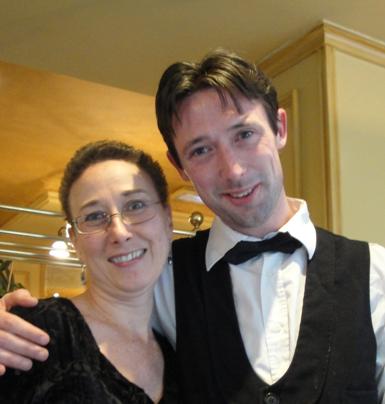
ImageCute to the bone with a boyish grin, Jonathan corrected my French matter-of-factly and took our picture with “But of course –  it is my second job: photographer.”

Unlike most American restaurants where you’re handed  multiple receipts in the ubiquitous black holder without explanation, he handed each piece of paper to me separately: “This is your receipt. This copy is for you.” He paused. “This one is for me. May I have your autograph please?”

Merci,” I replied.

I think I’m afraid to say anything in French for fear the natives will begin speaking to me as if I actually understand them. It happens, but the notion is quickly dispelled with a smile and an awkward “Non. Just bonjour.” They usually smile back and nod, understandingly.

I know it’s easy to forget things when you travel, but with a word of thanks in another person’s language and a smile in my own, things, such as toothbrushes, are easily replaced…so long as I don’t forget my manners.


© Copyright 2012, Jane Harkins. All Rights Reserved.


Trees of Life

In New Hampshire, twelve sugar maples circle our lawn
so vast it takes Dad on the tractor and me and Mom with wide wooden rakes
to roll the carpet of leaves, knee deep, to the edge of the woods

at the foot of a stand of white birch,
pencil thin trunks, golden yellow leaves,
papery bark I write love notes on

to send to my favorite ever boyfriend
in Alabama, who throws magnolia cones
for his retriever Beau to chase

into the pond, to fetch amidst
the roots of the weeping willow,
though I never cry when we we’re together

under loblolly pines at Chewacla State Park,
midnight blue, we make love
on the splintery picnic table

before I drive south, past orchards
of waxy green orange trees, the car
filled with the scent of wedding blossoms

through a mangrove swamp turning water a tannic brown,
the sun turning me dark like a cup of tea,
the smell of iron primordial

on the coast, I stand on a beach, invisible
in the sun’s glare against sand white as bones,
and hear the palm tree whisper to me.


© 2011, Jane Harkins. All rights reserved.

Anonymous

This morning I wake up late and have to rush to class. I dodge clumps of chatty women and veer wide to avoid a spreading amoeba of prospective students – teenage girls and boys in sleeveless tank tops, shorts and flip-flops, paying varying degrees of attention to their guide. I dance, left-right-left, with one of the disengaged-looking fathers before I stop, meet his eyes, and say, “You lead.” He smiles and steps aside to give me right-of-way.

Ahead I recognize the woman holding open the heavy metal gate for me, and I scoot through onto the public street. Her clothes are summer colorful. Our arms are free to hug each other, to wave goodbye.

My day is filled with this freedom of movement and unhindered choices: if I want to speak up in class, eat lunch outside with the sun on my face.

After dinner I hurry to the auditorium in search of our guest speaker, Masha. She and I find a private hallway where she holds a five-foot square of milky blue cloth. She gathers it in her hands toward the center – shaped like a pill-box hat and sized to fit over a small woman’s head – and holds it up for me.

Islamic women of hot, arid Afghanistan wear such a garment over their clothing. I expect it to be light, made from cotton or linen. I expect material that breathes, but the burqa is thick, for modesty, and slippery as chiffon.

Masha snugs the soft, fitted cloth to my head and lets the gathers fall below my knees. There is a net, the same milky blue, to look through. It is barely the width of my eyes.

I’ve lost my peripheral vision. I barely have any vision at all.

She says, “Did you know Afghan burqas are one-size-fits-all? All of them are this color.”

I feel as if she has said this from far away as I struggle to grasp the enormity of this information: All women. One size. One color.

I move my head and the burqa shifts. I tug the eye mask back into place so I can see out the hole; regardless, my entire world of vision has become a blind spot.

Masha asks, “Are you okay?”

“I’m good.”

She leaves me to begin her speech.

I strain to see through the lace grill, focusing on the door into the auditorium. I can’t see to walk. I tilt forward to peer at the floor, but the flowy sheet billows out and obscures my sight from that angle.

I look straight down inside the cage and realize this is my only unobstructed view. I see my feet, clad in flat, black shoes, my bright red toenail polish hidden like a dirty secret.

I step – peer up – focus through the mask – check down – step forward. Instead of two quick strides I’m reduced to barely a shuffle for fear of bumping into a wall, of tripping and falling. I reach for the door handle, but the fabric slides off my hand, and I can’t grab through it. I finger pinch the material into a handful, peer out, and try again. I’m successful, but I have to stop and tug the eye-way back into place.

Masha is speaking to the audience – hundreds of women and men, in their personally selected attire of scarves and dresses, shirts and slacks, in prints as varied as their personalities – listening to her read the poetry of Afghan women.

I picture the looks on their faces – perhaps annoyed at the rudeness of a latecomer arriving in the middle of our guest’s talk. Perhaps they shift in their seats when they see a person in the foreign garb of a milky blue drape that covers her like the sheet of a ghost.

I stand for a moment to gain my bearings. I’m cautious because I recall stairs ahead, but I can’t see them. I piece together a visual puzzle before each move.

In this halting, awkward fashion I reach an empty seat between two women, friends of mine who don’t know who I am.


© 2012 Jane Harkins. All rights reserved.
Colanders

Round as a smiling woman’s cheeks,
stacked and nesting
the colanders spoon in the cupboard.
Indifferent to differences
– the glossy yellow plastic mixing it up
with the gleaming metal –
they share their kitchen tales:

Red strawberries in May,
blue berries from Maine,
arugula and buttery Bibb
and spinach – like the best of men –
strong, yet tender.

The littlest sieve hangs by the sink,
bright and shiny as a child’s face,
freshly washed for Sunday school
of dirt and grit and bugs.
Shaped to hold the best in us,
letting go
of those things best not kept.

– Jane

© 2012 Jane Harkins. All rights reserved.
Why Not?

People say, “I’ll try anything once.” A few mean it – eating the hottest habañera pepper, jumping out of a helicopter to ski down a glacier – but most speak glibly. I try not to say it at all, in case someone is of a mind to dare me.

No one dared me to apply for a job at Target. In fact most people I told looked at me like, “What the heck were you thinking?” For a few the words fell right out of their mouths.
I was thinking I needed a job, and being a Human Resources manager didn’t sound so bad, what with the job being a mile from home and I’d get to wear khakis every day. Why the heck not?

So there I was on orientation day, being given the store tour by the bright and perky 22-year-old Chrissy. I’ve been shopping at this store longer than this girl has been alive – and she was going to be my boss.

She led her band of merry tagalongs past the freezer section, through electronics – I didn’t know Target sold iPads – around the toys section that ranged from pale pink baby dolls to green and black camouflaged ground pounders, and by the fitting rooms where Chrissy offhandedly said, “Jane, you’ll fill in here for breaks and lunch.”

My brain was processing this slowly: Jane – You’ll – Fill – In – What?! Did she say ‘Jane’? I’m covering the dressing room? I’m re-hanging women’s bras and re-boxing men’s jockey shorts and folding shirts the teenage girl dropped on the floor as I count hangers and hand out little plastic numbers?

This shock was just making an impression on me as we reached check-out, and this time I distinctly heard Chrissy mention, “Jane, you’ll cover here.”

I made it through class without babbling or breaking down in sobs. The next day I called and told Miss Not-Going-To-Be-My-Boss the job just wasn’t right for me…no matter how short the drive.

I’ve had a few more goofy job misses since then, such as the man who didn’t want to pay me. He liked my work – he just, really, didn’t want to pay me.

So there’s this job interview on Tuesday. In D.C. If I get the job either I’ll have to move or commute two hours each way.

I’ll try anything once.


© 2012 Jane Harkins. All rights reserved.
And

And I was taught never to start a sentence with ‘and,’ as though nothing – not a thought, not a whisper, not a big bang – happened before me.

Writing Prompt: Write a sentence starting with ‘And….’